
Rural Health Transformation in Georgia: A Historic Opportunity, and the Work That Will Define It
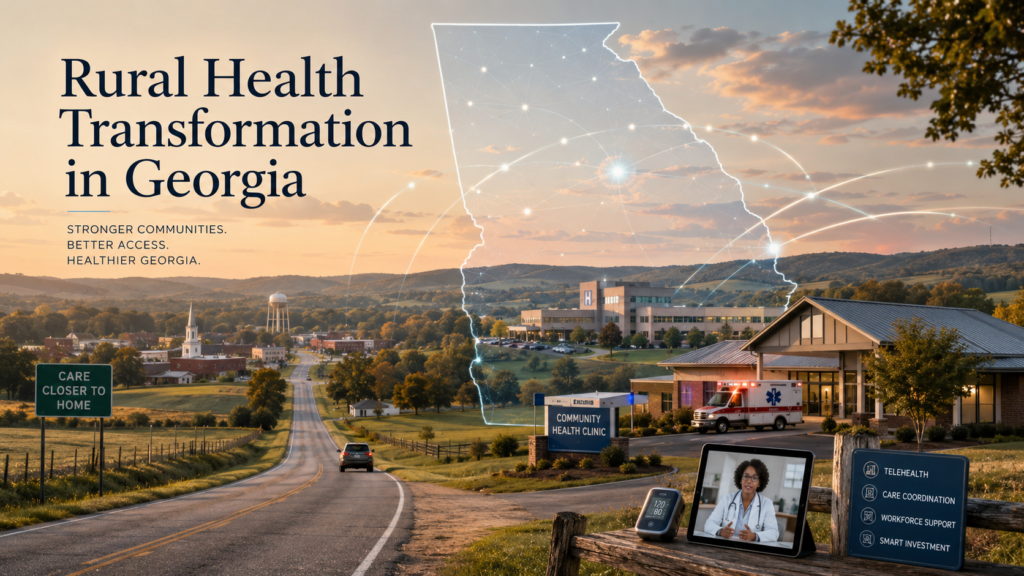
For anyone who has spent time in rural Georgia, the challenges are not abstract. A patient in the southwest part of the state may drive forty minutes or more to reach a physician. A county may have lost its hospital, or sit one difficult quarter away from losing it. Ambulance coverage may rest on a handful of crews stretched across hundreds of square miles. These are not edge cases. They are the daily reality for a large share of the state.
That reality is why the Rural Health Transformation Program matters, and why Georgia’s early position in it is worth understanding clearly.
What the program actually is
The Rural Health Transformation Program was created by H.R. 1, the federal budget legislation passed in July 2025. It commits 50 billion dollars over five years, distributed by the Centers for Medicare and Medicaid Services to states that apply and are approved. Half of the annual funding is divided evenly among approved states, and half is allocated according to a methodology set by the Secretary of Health and Human Services.
Georgia applied, and Georgia delivered. The state secured 218.8 million dollars for the first year, one of the largest first-year allotments in the nation, under the banner of the Georgia Rural Enhancement and Transformation of Health program, known as GREAT Health. State officials have outlined a roughly 1.4 billion dollar plan over five years, spread across more than two dozen projects and administered by the Georgia Department of Community Health. Eligible providers will compete for funds through a grant process, under one consistent condition: the money cannot be used to maintain the status quo.
That last point deserves emphasis.
Money is not the same as transformation
A historic investment is not, by itself, a transformation. It is an opportunity to transform, which is a different thing. The program is built to reward states that deploy funds well and meet performance milestones. The discretionary half of each year’s funding is recalculated based on how states actually execute, which means year one is not a guarantee of year two. Georgia’s strong start raises the bar for what comes next rather than settling it.
There is also a sober counterpoint worth acknowledging honestly. The same legislation that created this program also reduced Medicaid funding, and many rural Georgia hospitals depend heavily on Medicaid. Critics have reasonably asked whether transformation dollars can offset coverage losses. The straightforward answer is that they are different instruments addressing different problems, and pretending otherwise serves no one. Clear planning means holding both truths at once: the opportunity is real, and the structural pressures on rural providers have not disappeared.
The piece that tends to get left out
Most conversations about rural health transformation orbit around hospitals and clinics. That focus is understandable, but it is incomplete, and the gap is one I have watched play out for years.
In much of rural Georgia, the emergency medical services system is the health care safety net. When a hospital closes, the ambulance does not. EMS becomes the first and sometimes the only point of contact for acute illness, injury, and the slow-burning chronic conditions that go unmanaged when primary care is an hour away. Yet prehospital systems are frequently an afterthought in transformation planning, treated as an emergency response line item rather than as the community health infrastructure they have quietly become.
Transformation that overlooks EMS is not transformation. It is the renovation of one room while the foundation settles. Mobile integrated health, community paramedicine, EMS data integration, and workforce stabilization are not peripheral to rural health. In many counties, they are the difference between a functioning system and a vacuum. Georgia’s plan rightly emphasizes telehealth, workforce, and new models of care. The strongest versions of those investments will treat EMS as a partner from the first planning meeting, not a stakeholder to be consulted after the decisions are already made.
What this means for organizations
For hospitals, health systems, local governments, and provider organizations across rural Georgia, the months ahead are decisive. Funds must be allocated on a compressed timeline, the bar is set at genuine transformation rather than incremental relief, and future funding will follow demonstrated results. The organizations that fare best will be the ones that move from “what can we apply for” to “what change are we actually trying to produce, and how will we prove it.”
That is harder than it sounds, and it is exactly the kind of work worth doing carefully. A first-principles approach asks the unglamorous questions early. What problem are we solving? Who is genuinely served? What does success look like in measurable terms? How does this hold up when the funding formula tightens in year two and beyond?
Rural Georgia has waited a long time for an investment of this scale. The opportunity is genuine. Whether it becomes transformation will depend less on the size of the award and more on the clarity of the thinking behind how it is spent.